Application Story

ThyssenKrupp Body Stampings has slashed time spent installing new robot cells and fault finding on existing ones after investing in electro-pneumatic Airboxes from Kuhnke. These 'plug & play' modules diagnose themselves and by residing directly on a single ASi-based fieldbus communications loop, allow the car body parts producer to dramatically simplify its wiring

Based at Cannock Chase in the English West Midlands, ThyssenKrupp Body Stampings (TKBS) is now spending less time on maintenance and plant installation and more on actually producing car parts, following installation of a network of Airboxes from Kuhnke.

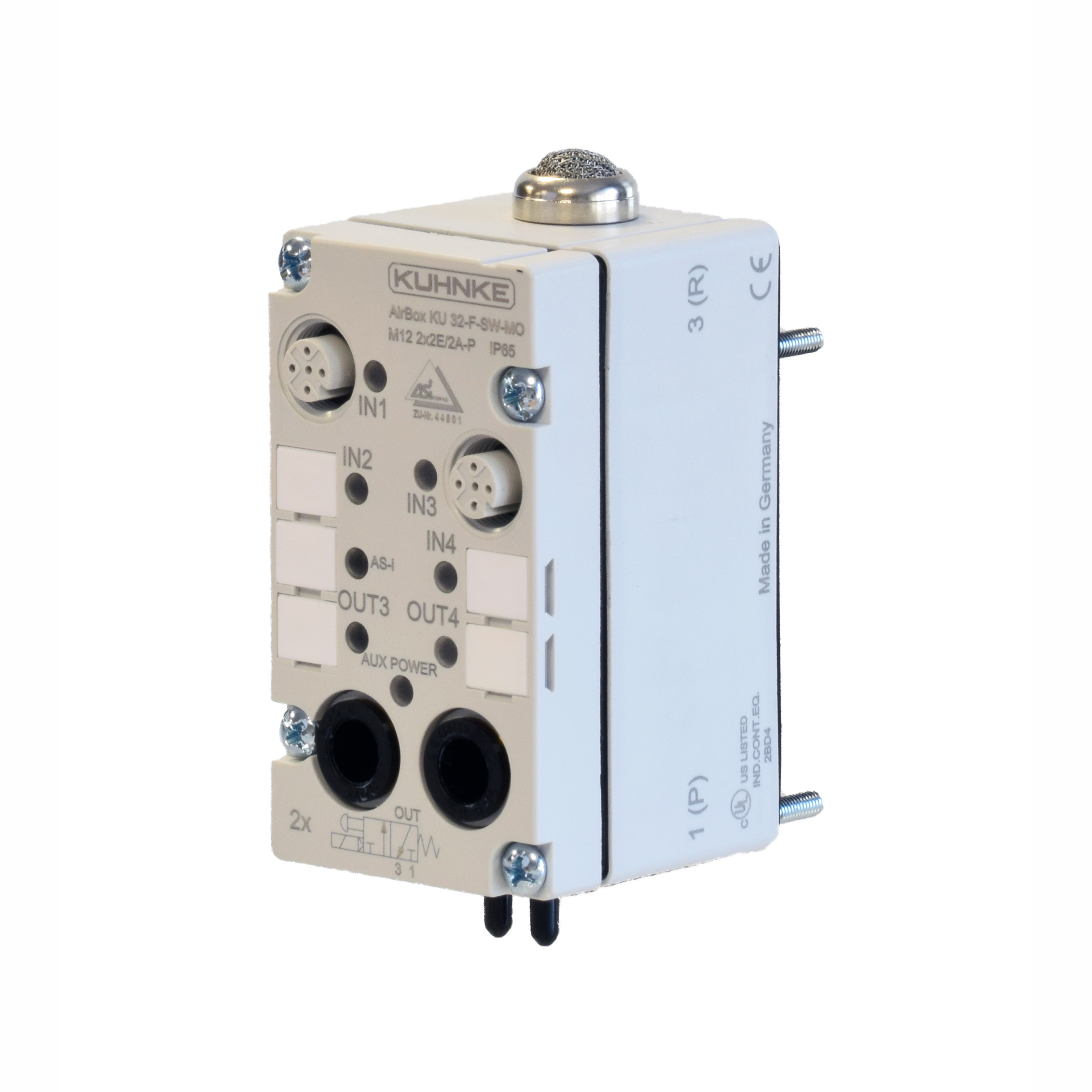
Hard working Airbox Looped on a two-wire ASi (actuator-sensor interface) cable, these Airboxes currently provide the Tier 1 automotive supplier with around 600 I/O points that reside directly on the physical-level fieldbus - unlike conventional valve islands. The electro-pneumatic network sits on a single data highway, ASi cable and regulates operation of 60 robot cells, performing largely presswork and spot/MIG welding tasks. Each cell comprises one to four robot arms - provided by GE Fanuc - that work round the clock.

ASi fieldbus replaces hard wiring

The ASi/Airbox system, has replaced a traditional control network based around pneumatic valves, with each island individually hard-wired to a central controller in a complex array.

Keith Jones, the assembly maintenance manager at TKBS, explained the decision to change: "Prior to my current role, I used to work in the research and development department here at Cannock. A colleague and I were looking at how to develop faster more flexible production systems and came to the conclusion that the main roadblock to improvement was the hard wiring system employed. It made installation of new robot cells time consuming and cumbersome, with lots of fixtures and fittings to deal with. Frankly, I couldn't believe we'd persisted with hard wiring for as long as we had."

Mr K Jones and Mr A Skowron persuaded management at TKBS that sticking with the wiring status quo was a false economy and he was given the remit to source an alternative integrated solution. "We looked at all the major fieldbus protocols, but none of them, with the exception of ASi, could provide us with a complete control and communication package that could talk to our robots and HMIs (human-machine interfaces)."

The car body parts producer became convinced that its requirement for an integrated modular production network could only be met by adopting the two-wire ASi fieldbus cable. This loop would reside at the plant's physical operating layer. Above it, Profibus provided communication between robots and welding equipment. TKBS production engineers opted for a control layer comprised of Siemens industrial Ethernet controllers to provide key production data.

The result was a hierarchical pyramid, which still managed to place relevant I/O points at the position most local to the actuator. Such a 'hand-in-glove' electro-pneumatic relationship was facilitated by TKBS' adoption of Airbox - a compact alternative to pneumatic valve islands - as its means of providing I/O capacity.

"Initially, we tried connecting some of our existing valve islands onto the installed ASi system," explains Keith Jones. "Whilst this system would have worked, the reasons for making the change to ASi - plug & play simplicity, quick installation and pinpoint diagnostics - would no longer have applied. When we tried it, we found that valves can't sit on the ASi cable. Instead, it would have been necessary to run a discrete adapter cable between each island and the fieldbus cable. In terms of speed and flexibility, this clutter would have been little better than hard wiring."

It was then that Mr Jones and Mr Skowron saw an advert for Airbox and became convinced that this electro-pneumatic module was the natural operating partner for ASi at his plant. "We need flexibility in the way we configure and arrange our robot cells. There may suddenly be high demand for a particular engine mounting bracket or roof support; particularly if a customer launches a new or updated model. In response, we mount our robots and turntables on moveable bases, so that production cells can be easily relocated and adapted as required."

Plug & play

The plug & play character of Kuhnke's Airbox module, each of which can be easily configured to provide up to 4 I/O, was crucial in providing TKBS with the flexibility it required. It therefore approached Kuhnke, who developed this revolutionary system and now market it in conjunction with Siemens - to help develop a simple complete system.

"Airbox contains all the required inputs built-in and is self addressing," confirms Kuhnke UK's Managing Director, Brod Bass.

Airbox in action Following a period of experimentation, TKBS proceeded to install the ASi/Airbox network, to work in conjunction with Profibus-linked Siemens controllers. "We were lucky in that there was no urgent time pressure on ourselves to install a new system, we could try and discard ideas - such as valve islands," said Keith Jones. "Both Kuhnke and Siemens were hugely helpful during this period, with advice and technical support."

The result was a series of Airbox modules set-up in a bi-stable arrangement. Each module is clipped directly onto the yellow two-wire ASi cable and configured to provide two independently programmable 5/2 input valves and four inputs. Power and communications signals are fed through the one pair of wires.

Mr Bass points out: "In some applications, control circumstances may dictate a two cable ASi solution is most effective. Here, control and power signals are discretely divided between the yellow and a black cable. One cable or two, it's easy to clip and unclip modules as required to modify production cells."

In addition, it's not necessary to pre-specify the function on the pneumatic node of each Airbox module - as would be the case with valve islands. Therefore, TKBS is at liberty to, for example, change between 5/2 and 3/2 configuration, without needing to start from scratch.

Fault finding

Should any part of the ASi network at TKBS develop a problem, an illuminated light pinpoints the source of the fault. Because Airboxes link directly onto the fieldbus cable, they benefit from this diagnostic facility in a way that remote valve islands cannot.

Mr Jones adds: "We moved away from the idea of a valve island solution partly because the adapter cables are effectively black holes when it comes to diagnosing a fault.

"Airboxes clipped onto ASi diagnose themselves. With the new system, if we have a problem it'll typically be fixed in 15-20 minutes. Before, six hours was common."

Other key features in TKBS' ASi network include the introduction of ASI safe. Items such as Siemens' E-Stop emergency stop button. Compliant with EN418 and rated to IP66/67, can be clipped directly onto the yellow cable and opens-up ASi/Airbox to Category 4 safety applications.

Use of the ASI safe has allowed TKBS to remove the array of safety circuitry present during the previous hard-wired regime, with the resultant streamlined simplicity providing quick response to any malfunction. "If there is a problem, it's so much easier to deal with since we began moving over to Airbox. One screw will open things straight up; there are no covers, gaskets or conduits to disassemble and reassemble - as is the case with valve islands. We now have a much cleaner pneumatic network to work with."

By creating an inherently flexible electro-pneumatic network, TKBS has been able to "localise its I/O structure', explains Keith Jones. Each of the 60 robot cells are sustainable in their own right, where operation is easily understood and straightforward to adapt. "Our manufacturing is based on a modular cell structure, where each workstation is based on the same basic design - it's just the capacity that changes.

"Airbox/ASi mirrors this modular design approach perfectly, with I/O easily unhooked and moved as required - just like our robots. The result is that, today, it takes us just one month to completely commission a new work cell. This timescale represents a 60 per cent saving compared with when we utilised hard-wired valve islands.

Welding This easy adaptability is crucial to the way the car component manufacturer works. As Mr Jones explains, following commissioning of the initial system, there have been adjustments and refinements over the following two years. "No new system is perfect in practice first time - no matter how well conceived the design. It's always a question of changing this and adding that. With ASi/Airbox there is no constraint on change."

Since changing over the first robot cell from hard wiring to ASi fieldbus, TKBS has now rolled out the complete fieldbus-linked Airbox system across the 60 robot cells. Keith Jones adds: "Every single robot now has Kuhnke airboxes connected to it.

Higher productivity

"The result is we are now working as effectively as possible; quoted lead times, to our customers, have never been shorter. The Airbox system has more than delivered on our expectations of productivity. After all, if you cut cell installation time by more than half and slash downtime - due to Airbox's fast diagnostics - there's far more time in the day to make car parts."

Such has been ASi/Airbox's success in allowing TKBS to meet its customers' demands for quick, high quality, low cost components that the Tier-1 automotive supplier has secured orders from Toyota, Nissan, LDV and Saab. TKBS is currently in the process of assembling up to 15 new robot cells, based around ASi/Airbox system, to produce various car components for its customers. "These projects have been in development for 12-18 months. Because of the self-addressing plug & play function inherent with Airbox, we're ready to pick-up the ball and run with production as soon as the customer is ready."
END

Editor Note: Latest figures released by the German manufacturers' association VDMA show that uptake of ASi has drawn level with the established Profibus fieldbus communication protocol. VDMA indicates that ASi and Profibus now each account for just over 10 million nodes when measuring fieldbus-based industrial automation installations.

Following a management buyout at the end of 2003, KUHNKE UK Limited is now an independent provider of electro-pneumatic technology, including: micro-pneumatic components, locking and holding solenoids, electronic controllers, networking and communications devices, mechatronic solutions and linear distance sensors.

ThyssenKrupp Body Stampings is a division of ThyssenKrupp AG. The company produces a host of bespoke under-the-skin automotive components for cars and vans. Customers include: Ford, Toyota, Renault, BMW/Mini, Saab, MG Rover and LDV

Press Enquiries:
Carl Bocock, Tubeworld Information Media Services, 36 Dundonald Road, Kilmarnock, East Ayrshire KA1 1RZ
T: 01563 53 51 51 F: 01563 53 51 52 e-mail carl@tubeworld.co.uk

Other Enquiries: Brod Bass, H. KUHNKE Limited, 21 Abbey Enterprise Centre, Premier Way, Romsey, Hampshire SO51 9AQ T: 01794 51 44 45 F: 01794 51 35 14 brod@kuhnke.co.uk - www.kuhnke.co.uk


ASi © 2007 H. Kuhnke Ltd | Contact | +44 (0)1794 514445
Web Development - Orionesque Ltd
Registered in the UK - No. 665193 - VAT No. GB207766451
Kuhnke

www.thetimerandcountercompany.com | sales@thetimerandcountercompany.com
Tel: +44 (0)1794 514445 | Fax: +44 (0)1794 513514